Self Taught Interior Designer’s Apartment, Hong Kong – 48sqm/516sqft
Our home in Kwun Tong is more than just forty-eight square meters of concrete and glass; it is the physical manifestation of a dream I carried long before my husband and I shared our first meal here. When we moved in after our wedding, the space was a relic of 1990—aged, worn, and marked by a “diamond-shaped” layout that many would find daunting. But to me, its irregular corners were not a flaw; they were an invitation to create a tranquil and cozy sanctuary.
My creative process was not a sprint, but a slow, intentional journey. I spent nearly sixty months—five years of patient searching—to find the perfect secondhand furniture pieces that now anchor our life. I lived within the digital walls of my mood boards long before I lived within these physical ones, using tools like Milanote to organize my inspirations and ensure my style remained consistent,. This discipline taught me that a home isn’t built; it is curated.
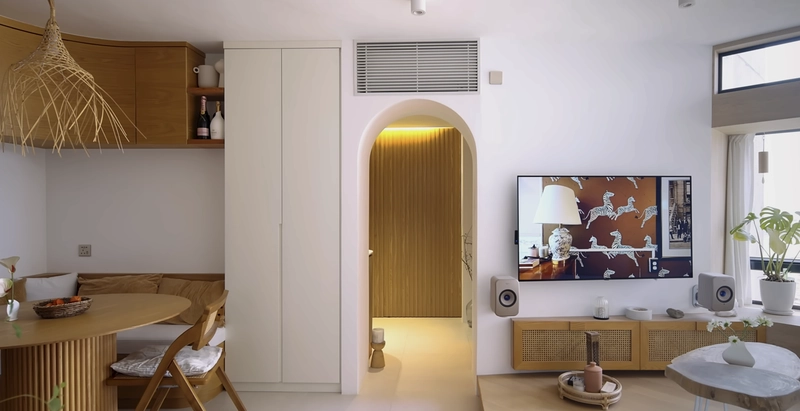
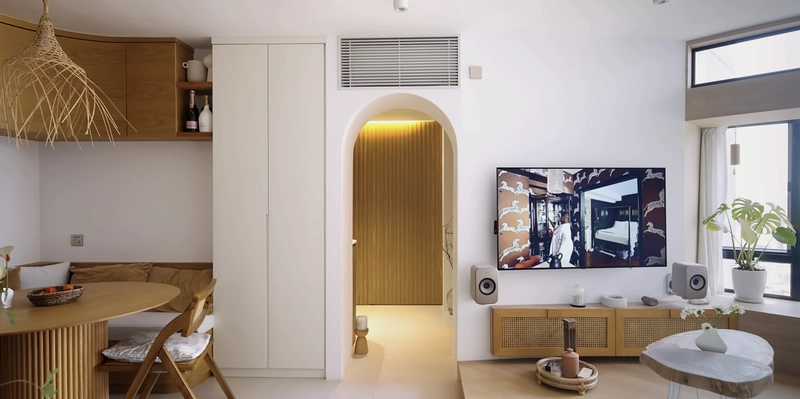
I felt a deep need to soften the rigid, irregular geometry of the apartment. By implementing arches and curves, I was able to lead the eye away from the awkward angles of the walls. I chose a palette of light and neutrality, painting the floors with white epoxy to pull in the natural sunlight and make the air feel lighter,. On the walls, I applied non-toxic Japanese lime plaster, a choice rooted as much in a desire for ecological health as in aesthetic purity.
Every corner of this home reflects a belief that functionality is a form of love. Because I wanted to save every possible inch of floor space, I replaced traditional doors with sliding ones and demolished bedroom walls to expand our bathroom. In the kitchen, I designed a narrow vertical drawer just to hide our mops and brooms, believing that a space free of visual clutter allows the mind to rest. Even our king-size bed is built high, a custom throne that hides our seasonal treasures beneath it,.
My heritage and my hopes for our future are woven into the very layout of the rooms. Influenced by Japanese traditions, I insisted on a foyer platform to leave the dirt of the industrial city at the door,. In the dining area, a circular table was non-negotiable; in feng shui, it is a powerful symbol of uniting the family. To me, that table is the heart of the house, a place where the booth seating wraps around us like a hug.
Even in the bathroom, I sought sensory peace. I used Japanese Aomori Hiba wood for the flooring and bathtub ledge, not just for its antibacterial properties, but for the way it connects us to the natural world in the middle of a business district.
Ultimately, building this home taught me that designing a small space requires a paradoxical mindset. You must be open-minded to the possibility of every corner, yet disciplined enough to spare blank space as a balance. In the silence of those blank spaces, I find the room to breathe, to dream, and to truly belong.