Redefining “Enough”: How One Family of Five Lives Large in 45 Square Meters
In the modern architectural landscape, a quiet revolution is taking place. As urban centers become more crowded and the “more is more” philosophy of the late 20th century begins to lose its luster, a new generation of homeowners is asking a radical question: How much space do we actually need to live well?
In the peaceful residential area of Heguri, Nara, Japan, a town characterized by its mountains, rivers, and rice fields, one family is providing a compelling answer. Nestled within this tranquil setting is a single-story home that defies traditional expectations of family living. Measuring just 45 square meters (483 square feet), this compact dwelling is home to a family of five—two parents and three children.
The Philosophy of Human-Centric Design
Architect Yosaku Tsutsumi, who focuses on architecture that harmonizes with nature, designed the home with a clear objective: to return to the “starting point” of human life,. According to Tsutsumi, modern housing trends have become obsessed with storage to accommodate an ever-increasing overflow of material possessions.
“Current housing trends are overflowing with things, and because of that, storage to put those things in is prioritized,” the architect observes. His design challenges this by encouraging a lifestyle where residents are not obsessed with owning things, but rather focus on living simply and beautifully. This shift in mindset allows the home to prioritize human activity over the accumulation of objects.
A Masterclass in Multi-Functional Space
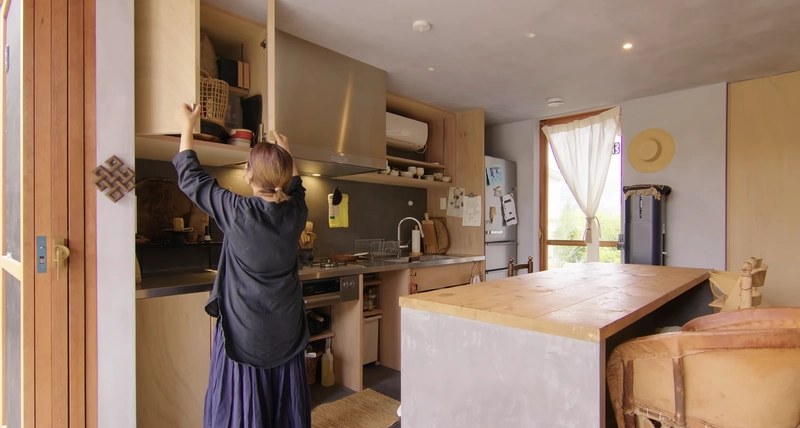
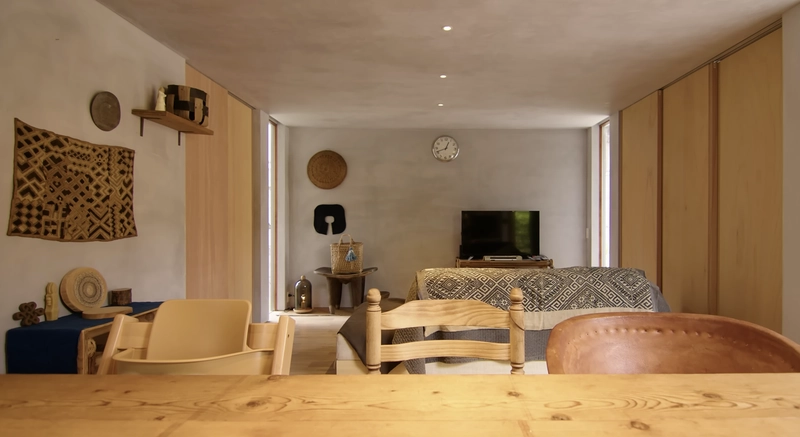
To make 45 square meters work for five people, every inch of the home must perform double—or triple—duty. The layout is centered around a combined living, dining, and kitchen (LDK) area that serves as the heart of the home.
• The Seamless Entry: The entrance features a “doma” porch, an outdoor living space protected by a roof that allows the family to enjoy the area regardless of rain or intense sun. This area includes a versatile wood box that serves as both a bench and shoe storage.
• The Adaptable Dining Hub: The dining table is oversized, designed not just for meals but also as an extended workspace for kitchen prep. Interestingly, the floor heights are varied: the dining area is set for sitting, while the kitchen side is adjusted so the cook can work comfortably while standing.
• Transformative Bedrooms: The main bedroom follows a traditional Japanese style where futons are laid out at night and folded away during the day, allowing the room to be used for other purposes. A second bedroom currently functions as a workspace but is slated to become a children’s room with bunk beds in the future.
Living with the Elements
The home’s exterior is as thoughtful as its interior. A striking wooden screen made of four adjustable panels stands at the edge of the property. These panels can be moved independently, allowing the family to adjust the balance between privacy and openness depending on how they are spending their day. Behind this screen, the house itself is clad in sleek Galvalume walls.
Inside, long, narrow windows are placed strategically to create a sense of “nukekan” (openness) and to draw in natural light,. The utility zone is equally efficient, combining the laundry, closet, and a drying area to ensure that chores are streamlined,. This allows the family to wash, dry, and store clothes in one continuous, breezy space.
The Future of Modern Living
This 45-square-meter home in Nara is more than just a feat of small-space engineering; it is a testament to a changing lifestyle. It suggests that modern luxury isn’t found in square footage, but in the quality of the light, the flexibility of the space, and the freedom from material clutter. By focusing on “living as a human being should,” this family has found that in a well-designed space, 45 square meters is not just enough—it is plenty.